
The 7-Day Game Plan
Improve one recurring problem in your home through guided practice and feedback.

Devin Trent
- One problem
- One plan
- 7 days of evidence
- Then we review what happened
Bring one repeated behavior that you'd like to improve so we can work through it together.
Imagine it’s 2:37 in the afternoon.
The younger kids have been with you all day.
You told yourself you were going to use this little window to switch the laundry, clean up the kitchen, start dinner, answer one message, maybe even sit down for five minutes before the older kids get home.
Then:
“Mom?”
“Mom?”
“Mom, can I have a snack?”
“Mom, look.”
“Mom, he took it.”
You look at the clock.
They’re going to be home soon.
Then the door opens.
Backpacks hit the floor.
Somebody’s hungry.
Somebody had a bad day.
One child needs help with homework.
The little one suddenly needs you right now.
You’re trying to start dinner while asking:
“Did you put your shoes away?”
“Where’s your lunchbox?”
“Did you wash your hands?”
And somewhere between the after-school snack and getting dinner on the table, you hear yourself say:
“How many times do I have to tell you?”
Can you relate to that?
Maybe your thing isn’t after school.
Maybe it’s bedtime.
Homework.
Shower time.
The plate that never gets to the sink.
The backpack you keep picking up yourself because you’re tired of looking at it.
Or the thing on the floor that only you seemed to see but nobody else saw it.
It’s that one thing that keeps happening on repeat.
Bring me THAT thing and we'll slow it down together.
Because being at home doesn’t mean you have unlimited time.
Even though people assume you do.
But little do they know, you can spend all day moving without ever feeling finished.
I’m opening 10 private spots in September for parents who want help working through one repeated situation like that.
Bring me the real version.
We’ll investigate it together.
Over seven days, we’ll figure out what deserves your attention, choose one small change to test, and see what your child can start carrying without you having to carry it for them.
You won’t leave with twelve parenting tips.
You’ll know what you’re trying, why you’re trying it, and what to watch for.
And want to make sure we're on the same page before we start...
The goal is not to pretend we know everything after one call.
I’m not going to talk with you for an hour and act like I suddenly understand everything about your child.
Their behavior is a clue, but it's not the conclusion.
So we start with the moment that keeps going sideways.
Not:
“My child doesn’t listen.”
But:
It seems like every night I have to go back and for with my child about bath time. They know it's bath time and they have to take a bath...so why won't they just do it?!? I'm trying to clean the kitchen after dinner and pack lunch boxes for tomorrow. I come up stairs expecting them to be in the tub but they're playing around on a school night. So I yell at them, which is something I hate to do, but I lost patience, temper and sometimes my sanity.
Those are the moments I can help you improve.
Tell me what happened?
What happened right before it?
What did you expect your child to know?
What did you actually say?
What did they do?
What did you do next?
Then we decide what deserves attention first.
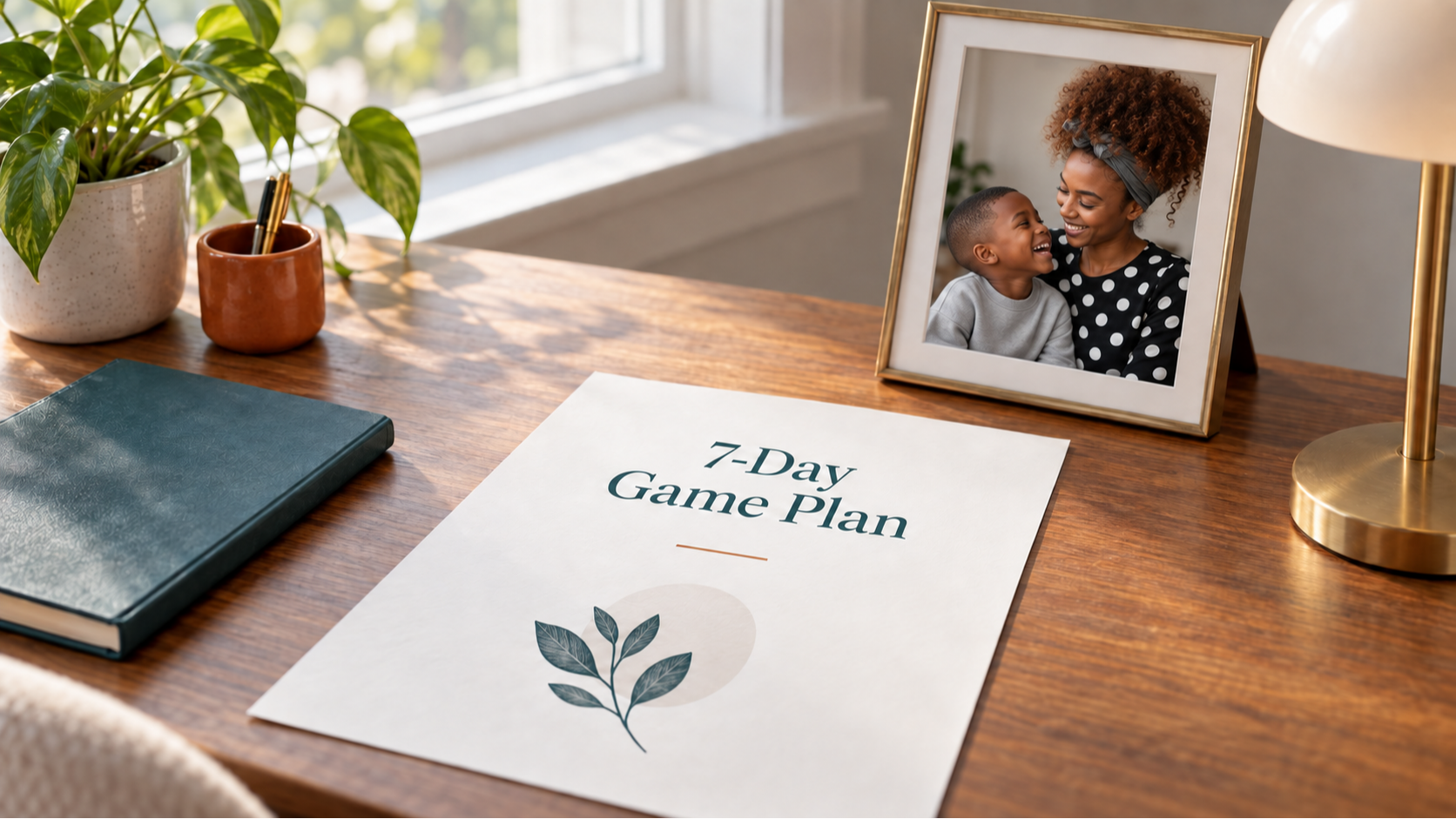
One situation. One clear practice. Seven days of real-life evidence.
You and I meet privately for 60 minutes.
We slow the situation down, separate what we can observe from what we may be assuming, and choose one useful place to start.
Then I build your 7-Day Game Plan.
One clear practice.
You’ll know:
This is what we’re trying.
This is what I’m going to do differently.
This is what my child gets to practice.
And this is what I’m watching for.
Then the plan has to survive your actual house.
The little one interrupts.
The older one is hungry.
Dinner still needs to be made.
Somebody is tired.
You are tired.
Maybe the plan works Monday and falls apart Tuesday.
Write that down.
Maybe your child remembers something you normally remind them about.
Write that down.
Maybe you stop reminding and absolutely nothing happens.
Good.
Write that down too.
We're not collecting gold stars. We're collecting evidence.
At the end of the seven days, you come back for your Private Feedback Review.
We look at what actually happened.
What got easier?
What stayed hard?
What did your child start carrying without you?
Where did you still have to step in?
What surprised you?
What should we repeat, change, stop, or test next?
Build it. Try it. Bring it back. We’ll review what happened.
Here’s what that looked like for one family.
Rochelle had been dealing with a repeat struggle around shower time with her son.
We made the expectations visible using a Family Agreement Board, including what Mom was responsible for too.
4 weeks later, Rochelle told me shower time wasn’t a hard time anymore.
Her son was following the agreement.
And because the rules went both ways, he had started holding her to them too:
“Mom, you broke the rules.”
That doesn’t mean the same tool is right for your family.
It means we stopped treating the surface behavior as the whole problem, changed something specific, and got something real to learn from.
That’s how I want to approach your situation.
Maybe seven days from now the win isn’t:
“My child never argues anymore.”
Maybe it’s 4:30 and the backpack is already where it belongs.
Maybe you’re making dinner and suddenly realize:
I haven’t had to reminded them yet.
Because they remembered.
Maybe you say something once instead of five times.
Maybe your child carries one step you normally rush in and do yourself.
Or maybe the week tells us:
That wasn’t the problem we thought it was.
That counts too.
Because now you know something you didn’t know seven days ago.
This is probably a good fit if you have one specific situation that keeps repeating, you’re tired of guessing what deserves your attention, and you’re willing to test one change honestly for seven days.
It’s probably not for you if you want a magic phrase that makes your child instantly obey, or if you want me to diagnose your entire family from one conversation.
That’s not what we’re doing.
We’re taking one real problem and putting one next move in contact with reality.
What if the first thing we try doesn’t work?
I can’t promise your child will stop the behavior in seven days.
Kids aren’t robots, and I won't pretend they are.
What I can promise is that we will not finish the week with:
“Just try harder.”
Or:
“Be more consistent.”
If the first practice doesn’t create the change we expected, your Private Feedback Review is where we use what happened to decide what makes sense to repeat, change, stop, or test next.
The first plan doesn’t have to prove me right.
It needs to teach us something true.
Investment: $197 one time
Your 7-Day Game Plan includes your private 60-minute call, your personalized plan, seven days of real-life practice, and your Private Feedback Review.
I can personally work with a maximum of 10 new private clients in September.
When those spots are filled, private enrollment closes for the month.
If there’s one moment in your house that keeps repeating, bring it.
The after-school blowup.
The repeated reminder.
The homework fight.
The bedtime negotiation.
The responsibility you’re tired of doing yourself.
We’ll slow it down. Choose one move. Try it for seven days. Then look at what actually happened.
[BOOK MY 7-DAY GAME PLAN]
P.S. Don’t clean the story up before we talk.
The next time it happens, open the Notes app on your phone.
Write down the time.
What you were trying to get done.
Who was there.
What you said.
What your child did.
And what you did next.
If the answer is:
4:42pm I was trying to start dinner. The little one was asking for a snack. His backpack was still in the hallway. I had already asked twice. Then I picked it up myself because I was tired of looking at it.
Bring me that.
That’s where we start.